Overview of Southern Shaolin Choi Mok Pai Fist
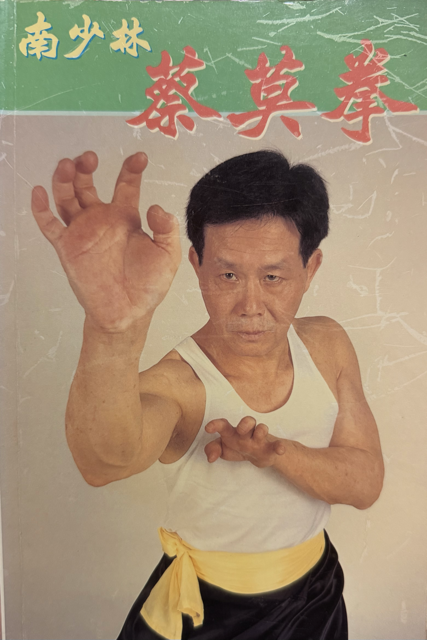 Choi Mok Pai Lau Biu 蔡莫派 劉標
Choi Mok Pai Fist originates from Fujian Shaolin Temple and spread throughout Chaoshan and Hailufeng regions. It is one of the important southern Shaolin fist systems in eastern Guangdong.
According to local records, Fujian Shaolin Temple was built during the Tang Dynasty Qianfu period (AD 874–889). In the late Ming and early Qing, the temple reached its peak. During the Kangxi reign, the Qing court accused the temple of "military training and plotting rebellion," sent troops to burn it down, and it is said several high monks escaped. The surviving monks scattered, each passing on their skills, and thus southern Shaolin fist spread widely among the people. Among the most widely spread were the five major schools represented by the Shaolin disciples Hong Xiguan, Lau Sam Ngan, Choi Kau Yi, Lee Sik Hoi, and Mok Ching Giu—namely, the Hong, Lau, Choi, Lee, and Mok schools. Each has its own strengths and characteristics.
Choi Mok Pai Fist was founded by Lau Si Chung (nickname: Sam Gok Fu) of Jiazi Town, Lufeng City, who integrated the essence of the five major schools, further incorporating techniques from Chu, Fan, Chung, Luk Hap, Taiji, and more. He also received in-depth instruction in Shaolin internal methods and practical fighting skills from Jiangxi martial arts master Cheung Man Wing, refining and synthesizing them into a unique and distinctive new system.
Like other southern Shaolin fists, Choi Mok Pai Fist emphasizes form, spirit, and the use of qi to drive power. Power is delivered through stable stances, fierce movements, and requires the force of hands, body, waist, and legs to be unified. Techniques are rich, specializing in close-range and short strikes, with fierce and tricky moves.
However, Choi Mok Pai Fist also has its own subtleties. Every movement and checkpoint focuses on practical combat, avoiding flowery moves unrelated to fighting. The requirements for body posture are strict: when striking, the elbow does not fully extend, but remains slightly bent to allow for rotation and change, sensing the opponent's force and enabling immediate counterattack. Choi Mok Pai Fist excels at fighting, adopting an all-offense approach, using both real and feint, skill and force together. Strikes are fast and powerful, stances are stable but not sluggish, bridge hands are firm, power is transmitted section by section, muscles and tendons are elastic, and the fist can strike even in tight spaces. Against incoming attacks, it advances rather than retreats, using the waist and shoulders to generate counterforce. Unlike other schools that advocate "yield to fists, chase the staff," Choi Mok Pai's principle is "do not yield to fists, chase as soon as you see the hand." Both hands are equally agile and proactive, with counterattacks coming in continuous waves.
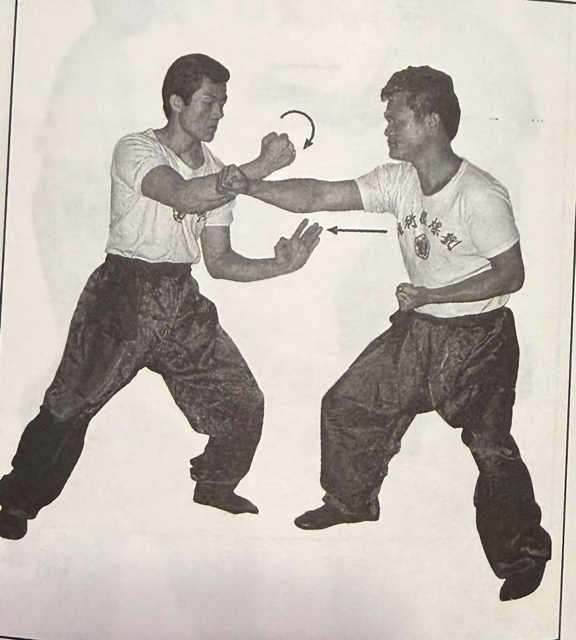 Choi Mok Pai Che Sau 蔡莫派 車手
As an all-offense system, Choi Mok Pai Fist naturally uses close-range attacks and short, explosive power. It also features a kind of internal power from the dantian—"fast power" (sok ging). When it hits, it is like an explosion, with a lingering rotational shock. This "fast power" is a hallmark of Choi Mok Pai and one of its most advanced skills.
Choi Mok Pai Fist often combines offense and defense, using techniques like smashing, snapping, sudden stops, and charges, with sudden bursts or hidden power to penetrate the opponent's organs, bones, and joints. The force is heavy and fierce, causing the struck to feel as if shocked by lightning. The techniques are tight and rapid, never striking or retracting the hand in vain. Every move is purposeful: if not charging, then smashing; if not lifting, then chopping; if not sealing, then locking; if not circling, then entangling—ensuring the opponent cannot retreat or escape, with hands and feet sealed and body trapped, falling into a passive position. Choi Mok Pai especially emphasizes two-person drills, using partner handwork to seize and control position.
Although Choi Mok Pai Fist originates from Fujian Shaolin, after decades of practice by Lau Si Chung, it developed its own unique methods. Some of these include:
Principles: swallowing, spitting, floating, sinking, hard, soft, yin, yang.
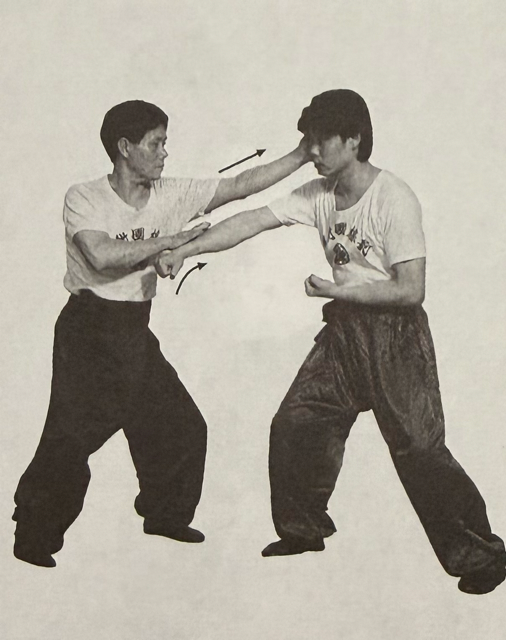 Choi Mok Pai Windmill 蔡莫派 風車手
Hand techniques: lifting, circling, combing, supporting, ham, binding, inserting, biu, sticking, pressing, leading, sending, scraping, pulling, grabbing, leaking, etc.
Palm techniques: ziu joeng, windmill, yin-yang, luk hap, thunder, etc.
Kicking techniques: chicken support, hook step, tiger tail, lifting snap, horizontal and vertical support, continuous scissors, mandarin duck spin, carp tail, etc.
Leg techniques: upward groin kick, piercing, sweeping, yin-yang locking leg, etc.
Footwork: snake step, mouse step, jumping, plum blossom, grinding, goat tail, lost step, etc.
Stances: head gate, second gate, triangle, sei ping, slanting, iron clamp stance, etc.
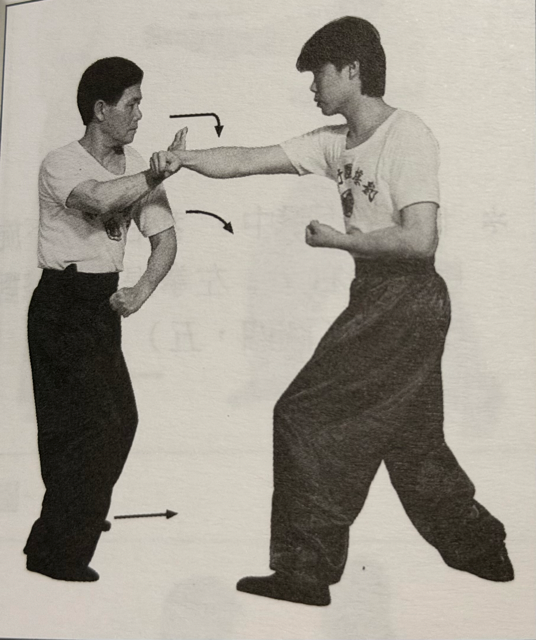 Choi Mok Pai Bin Kyu 蔡莫派 鞭橋
Power: returning force, spiral force, following force, unloading force, borrowing force, and "eating force"—the last being the most subtle and ingenious.
"Waist, stance, and shoulders as one, seven degrees of force at the start" are also features of Choi Mok Pai. It values not only forms but also single-move practice and especially two-person drills. The hands are rigorously trained, with sensitivity rivaling internal styles and unmatched destructive power. Among the advanced close-range techniques are "three-string hand," "binding hand," "internal and external chaining hand," "grinding stake and locking," "snake on water," "Fengyang biu finger," "willow in the wind," and "flower-mist hand."
Choi Mok Pai Fist forms include:
Beginner forms: che lun sau, che zhan gun, che da, che lun biu zi, internal che sau, soft che sau, che whip hand.
Intermediate forms: cha da, monkey strike, four points, six points, seven-step reversal, slanting battle stance.
Advanced forms: tiger-eagle double form, power adjustment hand, wind-thunder hand, whip bridge, tiger stretching waist, flower-mist hand.
In weapons, Choi Mok Pai is most famous for its staff techniques, which, while not claimed to be unique, are superior to many so-called "famous staffs." These include three Shaolin staff sets: 1) yin-yang spring-arrow staff (over ten sets), 2) green dragon staff, 3) half-slant-moon staff. Other renowned weapons include "luk hap double mace," "luk hap saber," and "double-headed bench."
Because Choi Mok Pai Fist absorbs the strengths of many southern Shaolin systems, it is both internally and externally unified. After long-term combat refinement, it has developed into a distinctive and outstanding southern Shaolin style. Since its founding by Lau Si Chung, it has spread widely, flourishing in Chaoshan, Hailufeng, Dongjiang, Hong Kong, and Southeast Asia, producing many talents. His son Lau Yuen Shing has worked to promote it in Hong Kong, with countless students after decades of effort.
After generations of transmission, Choi Mok Pai Fist has become a complete, sophisticated, and highly practical martial arts school, loved and respected by martial arts enthusiasts.
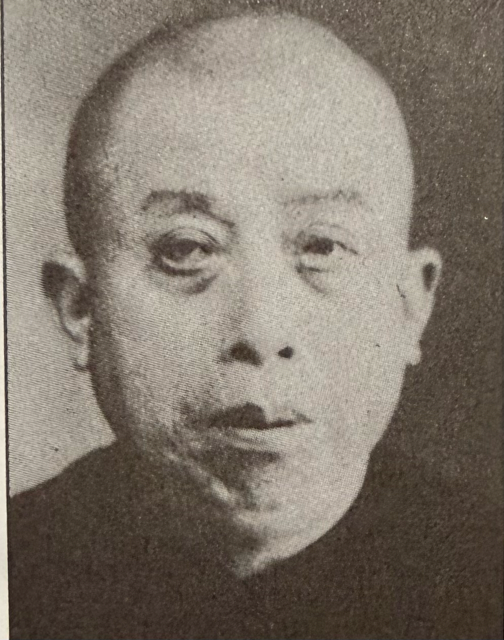 Choi Mok Pai Founder Lau Si Chung (劉仕忠)
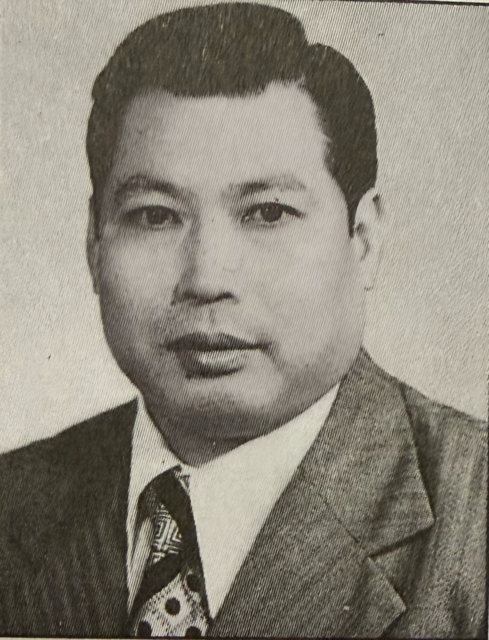 Choi Mok Pai Grand Master Lau Yuen Shing (劉遠成)