Choy Lee Fut — Chapter 3: gwaa ceoi
Meaning of “gwaa” — gwaa ceoi 掛搥
In Choy Lee Fut 蔡李佛 terminology the “gwaa” formula covers a broad set of techniques: heavy, resolute strikes with an aggressive forward intent. In practice, gwaa ceoi 掛搥 is often paired with saau ceoi 捎搥 (a follow or snap strike), hence the well-known linked combination sometimes called “linked gwaa–saau.” Standing alone, gwaa ceoi 掛搥 expresses a heavy, fearless power that is released when the opportunity appears. Regardless of the opponent’s posture, stance or hand positions, gwaa ceoi 掛搥 is applied proactively to attack vital targets. In combat it strikes back against incoming techniques, breaks forms when necessary, and aims to deliver overwhelming force.
Literally “gwaa” (掛) can mean to hook or lift upward; in the boxing application each strike typically issues from the center, moves over the head, then drops—these movements are classified as outer or inner hand actions. Outer-hand gwaa ceoi 掛搥 are usually aggressive, best paired with saau ceoi 捎搥; inner-hand variants are more finishing/killing techniques and suit chained swinging strikes. In any case gwaa ceoi 掛搥 remains an offensive, initiative-taking method.
Power generation of gwaa ceoi 掛搥
Like many hand methods, gwaa ceoi 掛搥 has no single fixed form. The palm issues from the center, travels over the head and descends; the palm drives the bridge-hand in a fan-shaped arc forward without pause. What is visible is only the silhouette of motion. In combat, when the opponent meets the strike with their bridge-hand or any limb, that contact often assists the gwaa ceoi 掛搥 to achieve its purpose: the primary intent is to strike. If the opponent’s bridge-hand connects with the incoming gwaa, the strike can continue past the bridge to hit the area behind it.
A useful metaphor: the whole gwaa ceoi 掛搥 structure is like fitting a hard hammer onto a flexible vine. Power begins in the vine’s motion, and as movement matures the hammer can swing and drive the vine into a circular path. At the attack’s peak the hammer’s motion may temporarily free itself from the vine’s constraint, producing a powerful, penetrating effect.
Types and variations of gwaa ceoi 掛搥
Technically, gwaa ceoi 掛搥 divides into two major categories—internal (inner-door) and external (outer-door) variants. Forms include zi ng maa 子午馬 inner gwaa, upper-stance (rising) gwaa, turning gwaa, gwaai maa 拐馬 (turning-step) gwaa, and side-suspended (diu maa 吊馬) gwaa. Each variation expresses its characteristics in different tactical situations.
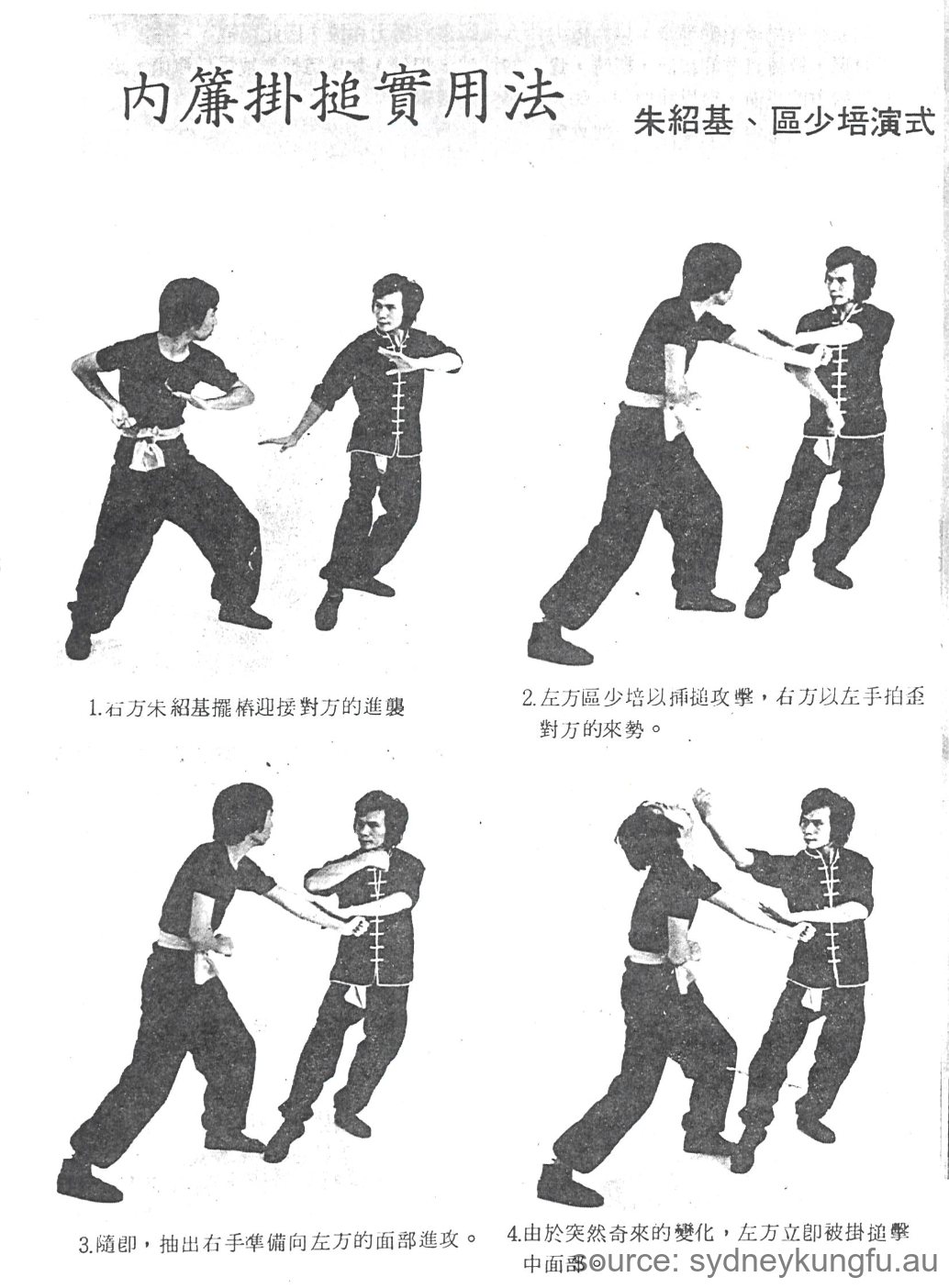
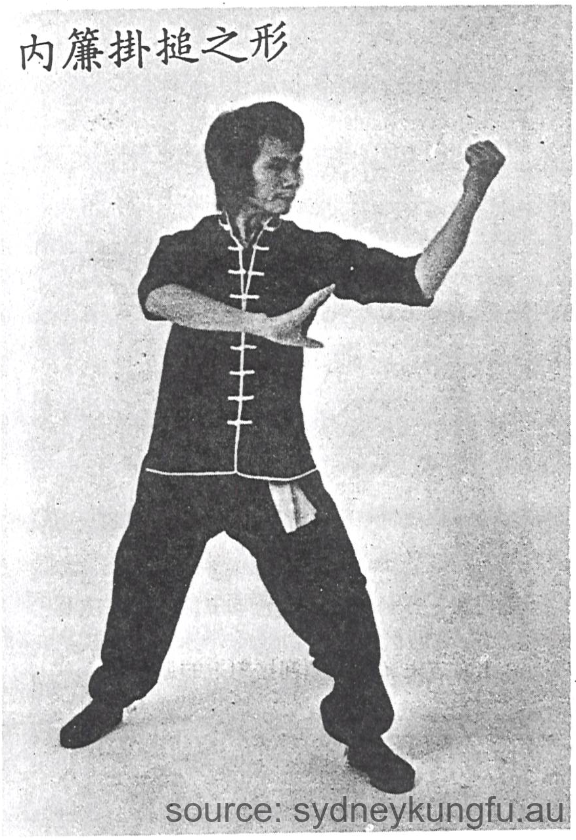
The zi ng maa 子午馬 internal gwaa differs from many outer gwaa in that it is often a late-arriving, intercepting method. For example, if my bridge-hand and the opponent are within less than a step and the opponent steps in to strike my bridge and simultaneously attacks my upper line, I may abandon the bridge position, close half a step to borrow leverage, and rotate from the elbow to wheel around the opponent’s bridge. At that moment my elbow presses the opponent’s bridge and the gwaa ceoi 掛搥 can be launched as if into an unguarded space. If this turning gwaa is combined with a clap or supportive hand motion, the strike can be delivered without worry of a counter.
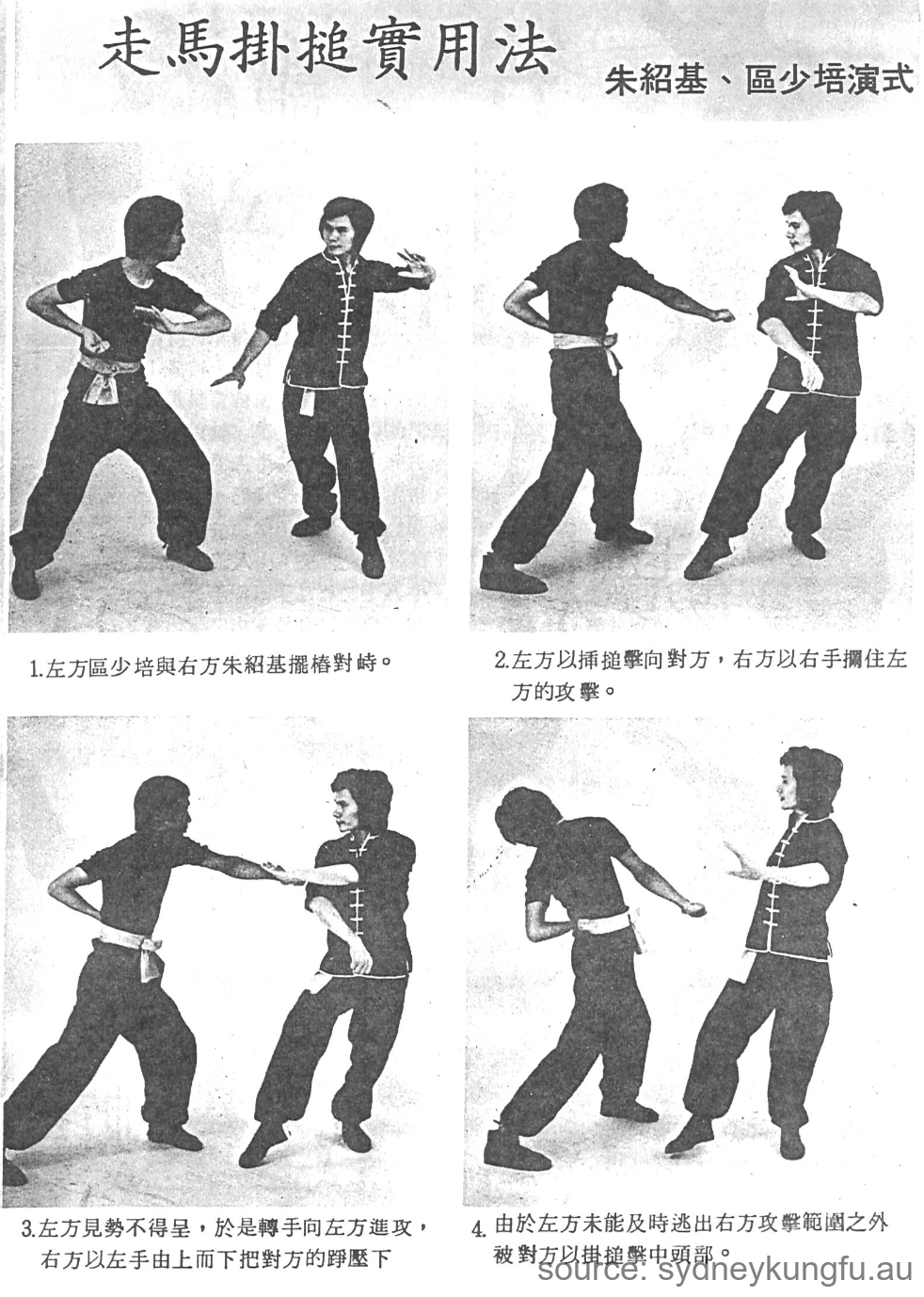
Both zi ng maa 子午馬 internal and side-suspended (diu maa 吊馬) variants function similarly in battle, but the side-suspended variety often places the striker outside the opponent’s attack range. Although a practitioner can sometimes use gwaa ceoi 掛搥 without auxiliary hands, Choy Lee Fut 蔡李佛 training commonly pairs every outgoing strike with a supporting hand—both for protection and to help the following technique. Since zi ng maa 子午馬 and side-suspended gwaa are often internal methods, successful application tends to strike the opponent’s upper line.
Upper-stance gwaa is commonly paired with ding zoeng 頂掌 (a rising palm) and followed by chained gwaa–saau–biu sequences to produce relentless offense. When an opponent presses forward into an upper-stance, controlling the engagement often still requires a gwaa ceoi 掛搥 to clear space: a body turn into a turning gwaa may strike from head to abdomen along the centerline, hitting the opponent’s hand-bridges and openings to break their formation.
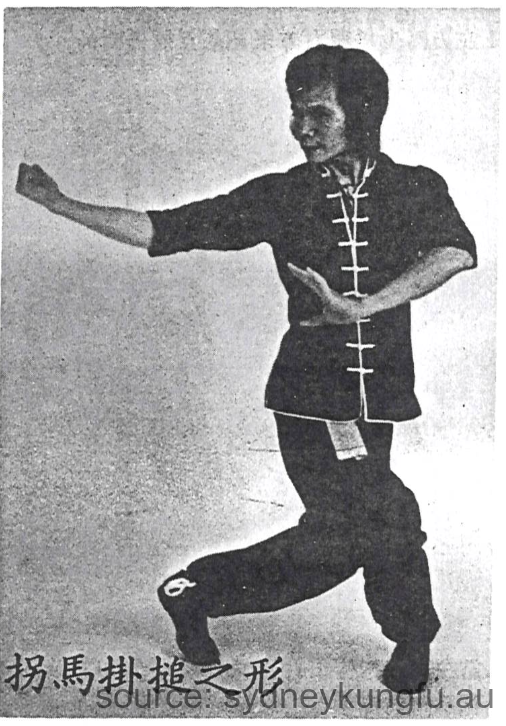
When surprised by a fast incoming attack and uncertain of the opponent’s technique, one can use gwaai maa 拐馬 turning-step gwaa to drive a descending strike into the charging opponent. This blow collides with the attacker’s forward momentum, creating a powerful impact; a successful hit in this situation typically inflicts significant damage.