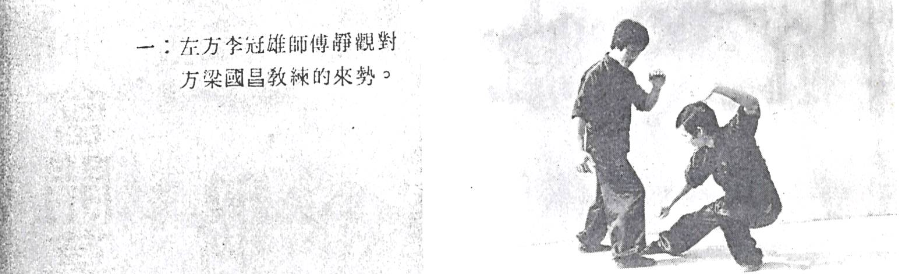
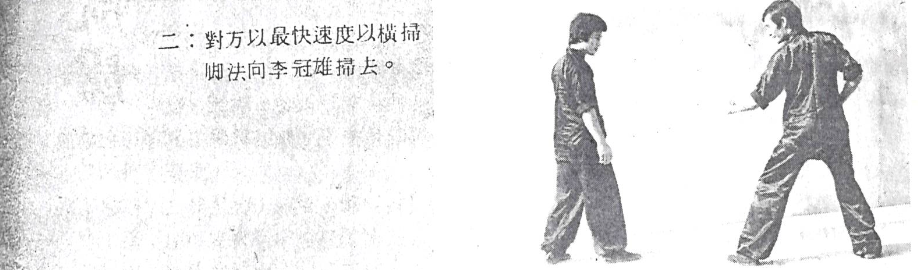
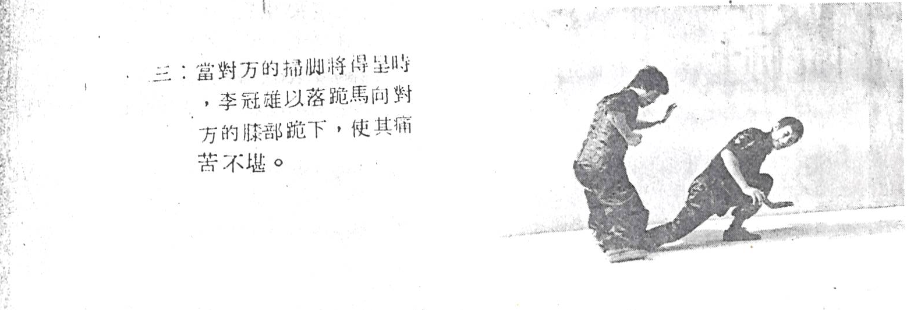
Choy Lee Fut Practical Stances Demonstration by Master Lee Koon-hung and Coach Leung Kwok-cheong
Practical Stances
Demonstration: Master Lee Koon-hung & Coach Leung Kwok-cheong
Regarding stance techniques, the previous issue provided a very detailed analysis. However, there has never been a comprehensive review of the true value and position of stances within the entire martial arts system. There is an old saying in martial arts circles: “Before practicing punches, practice stances first.” This mostly implies that one must develop a solid stance foundation before learning to strike. However, the crucial application of stances in actual combat seems to be somewhat overlooked, particularly their devastating offensive capabilities, which are rarely discussed. Although the core principles have yet to be clearly explained, the combat applications of Choy Lee Fut stances are vividly demonstrated in these pictures and explanations, detailing their usage and effectiveness. All photos are demonstrated by Master Lee Koon-hung, Head Coach of the Sik Ying Sports Association, and Coach Leung Kwok-cheong. These precious materials are a rare treasure in the contemporary martial arts world.
Lee Koon-hung, a young Choy Lee Fut master at 33 years old, stands 5 feet 7 inches tall and weighs about 140 pounds. From his appearance, he has a very robust martial artist’s physique, yet his conversation is humorous and scholarly. He has always been in the piece goods business but formed an indissoluble bond with Chinese martial arts since childhood. Thanks to his natural intelligence and diligent practice, Lee Koon-hung’s martial arts progressed by leaps and bounds. In just about twenty years, his martial arts mastery has reached a level of perfection and profound excellence.
Lee Koon-hung was born in Shunde, Guangdong, a rich and beautiful land. At the age of four, his family left their hometown and moved to the bustling city of Hong Kong. At age ten, a classmate brought him to a fitness academy to learn martial arts. After a long period of practice, Lee felt unsatisfied with both the form and combat effectiveness of the martial arts he was learning. Thus, at twelve, he and his classmate sought out another famous master. Introduced by his classmate, he became a student at the Poon Tik Sports Association, learning Choy Lee Fut. After rigorous training, he gradually grasped the essence of Choy Lee Fut and gained insight into techniques like grabbing, seizing, hanging, swiping, and thrusting. At the time, Poon Tik’s senior disciple, Master Leung Sai, recognized his potential and taught him everything he knew. Deeply favored by his master, Lee trained joyfully and dedicated most of his time to studying under Leung Sai. Eventually, Leung Sai recommended Lee to further his training with his senior uncle, Chow Bing. Chow Bing was also incredibly fond of Lee Koon-hung and gladly accepted him for advanced training.
Through years of hard study, Lee Koon-hung excelled not only in Choy Lee Fut fist techniques but also in various weapon arts. His skill with the “Double Dragon Broadswords” is particularly notable. Characterized by the harmonious blend of yin and yang, tight yet agile movements, and extraordinarily beautiful postures, Lee Koon-hung’s swordplay brought him fame overseas when he performed in Hawaii, earning much attention from compatriots there.
Circling Stance Method (Huen Ma)
Circling Stance (Huen Ma): Also known as the Twining Silk Stance (Cin Si Ma) or Twist Stance (Nau Ma). Despite the different names, they are essentially the same. In terms of static posture, the Circling Stance, Stealing Stance (Tau Ma), and Turning Stance (Gwaai Ma) look identical, but the process of executing them is very different. For example, in the Circling Stance, starting from an “M” shaped Four-Point Horse Stance (Sei Ping Ma), you simply lift the front foot slightly and turn the foot direction by 180 degrees. The body follows with an extreme rotation. At this point, the stance forms an “X” shape, while the body maintains the same balance as in other stances. The majority of the power is now concentrated on the front leg, making the rear leg nearly auxiliary.
Meridian Stance (Zi Ng Ma): Also called the Bow-and-Arrow Stance (Gung Zin Ma), meaning its shape resembles a drawn bow fitted with an arrow. The front leg bends at the knee like a tightly drawn bow, while the back leg extends straight like a ready-to-fire arrow. The waist and torso are positioned similarly to the Four-Point Horse Stance, but the orientation shifts from the front to the side, aligning with the direction of the bow. During practice, as you continuously switch between the left and right Bow Stances, the waist rotates with the changing stance, creating an extreme shift in orientation. The purpose is to develop agility and maintain body balance through continuous changes, while properly conditioning the waist for flexibility.
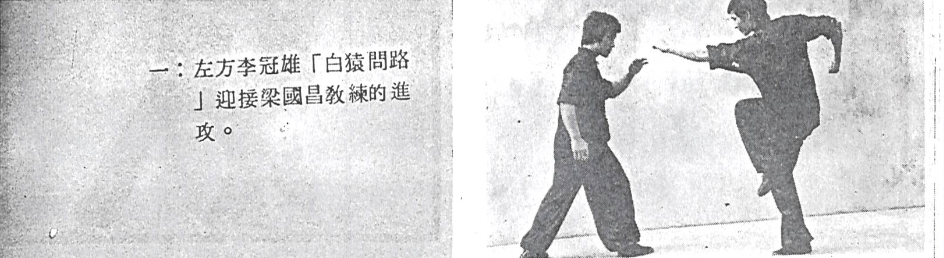
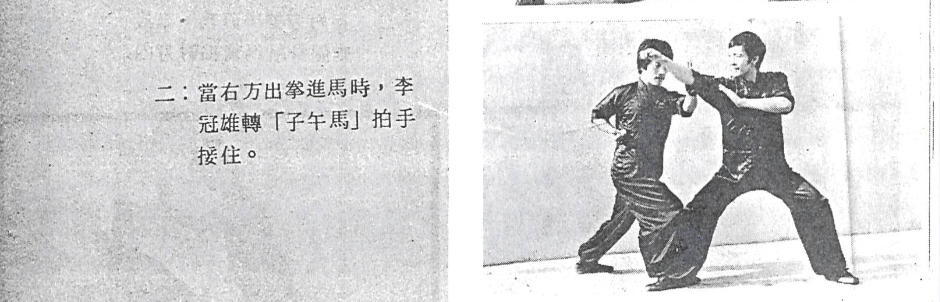
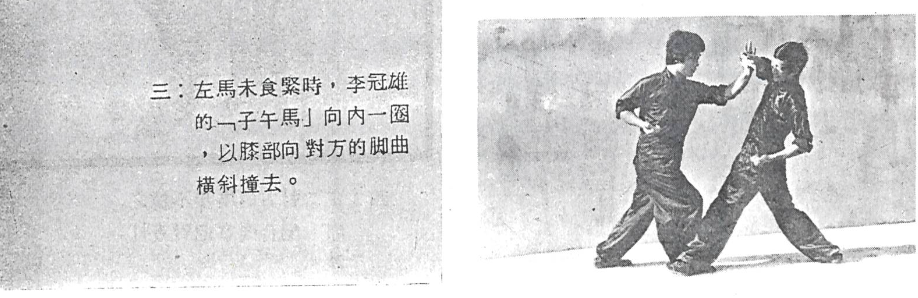
Stealing Spring Stance Method (Tau Taan Ma)
Hanging Hoof Stance (Diu Tai Ma): This is a stance with one empty (false) and one solid leg. The waist and torso maintain balance. The front leg holds no weight (empty), while the slightly bent rear leg acts as the main support (solid). The body leans slightly, facing the same direction as the front toe. Since the front leg is essentially a feint, the entire power of the hanging leg is concentrated in the thigh, making the section from the toe to the knee completely weightless, like a directional needle. The overall shape of the Hanging Stance resembles fishing over a deep abyss, with clear distinction between empty and solid. During practice, the empty/solid states can alternate instantly, creating a strong contrast and an extreme change in direction.
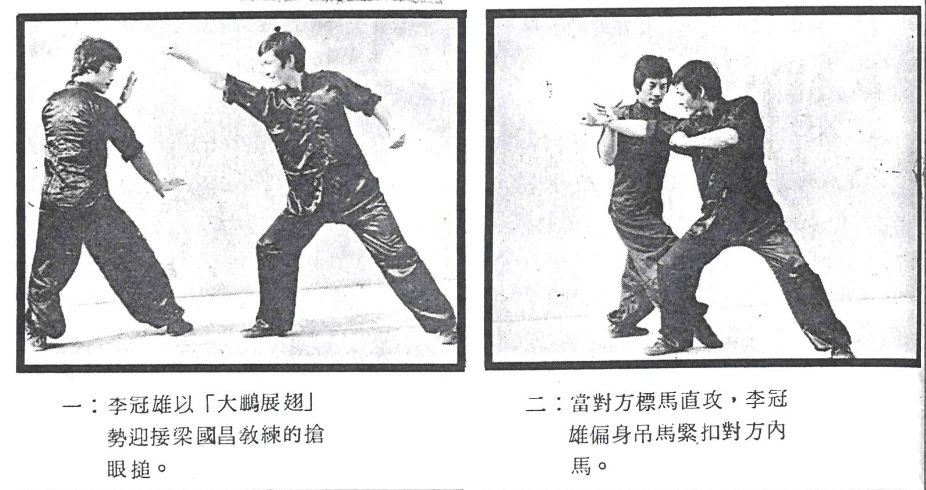
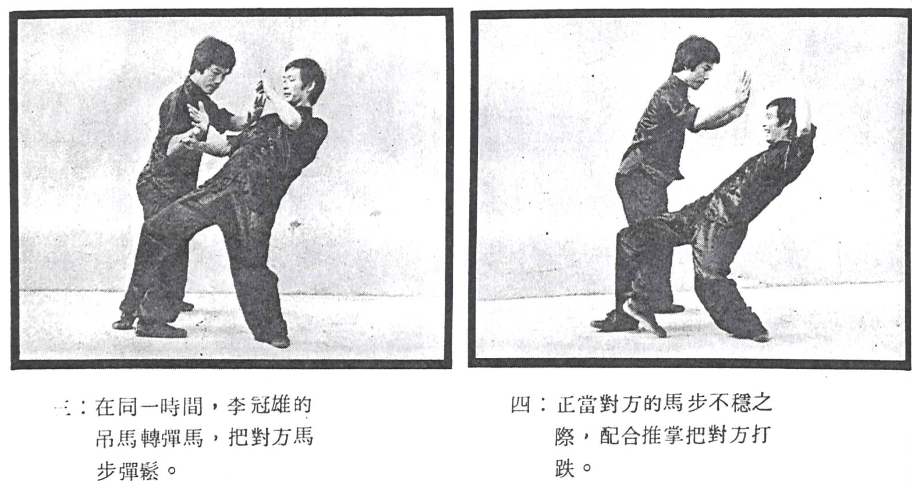
Dropping Knee Stance Method (Lok Gwai Ma)
Dropping Knee Stance (Lok Gwai Ma): This is a low stance requiring fully bent knees. The body leans slightly but remains straight. Whether punching or kicking, the power is concentrated between the knees and legs. Moreover, power can seamlessly shift entirely to one leg at any moment, turning it into an empty/solid stance. During left-right transitions, the waist pivots naturally to maintain the body’s center of gravity. Everything reacts entirely out of natural reflex.