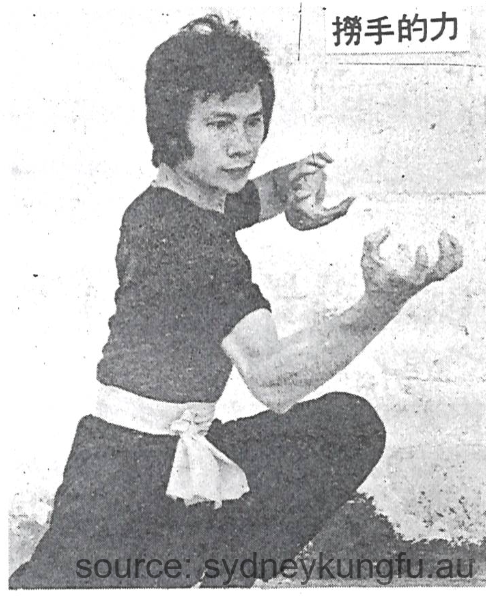
Choy Lee Fut - Lao Sau by Master Chu Shiu Ki
The Relationship Between Na 拿 and Lao 撈
Na Sau 拿⼿ and Lao Sau 撈⼿ sound similar, and in terms of principles, they share many similarities, sometimes being exactly the same. • For example, Gwaai Maa Na Jam 拐馬拿陰, Gwai Maa Na Jam 跪馬拿陰, in terminology: “hai dei lao jyut 海底撈月”. Even Sei Ping Soeng Na 四平雙拿, Cyun Na 穿拿, in form are close to Lao Sau 撈⼿. In Choy Lee Fut 蔡李佛 hand techniques, there is also Cyun Lao 穿撈. In both movement and purpose, they are the same, so Na 拿 and Lao 撈 are distinguished by pronunciation, but in essence, there is no difference. As for the origin of the Na 拿 sound, it is believed to be related to dialect, like how in Choy Lee Fut 蔡李佛, Saau Ceoi 捎搥 is called Saau Ceoi 哨搥.
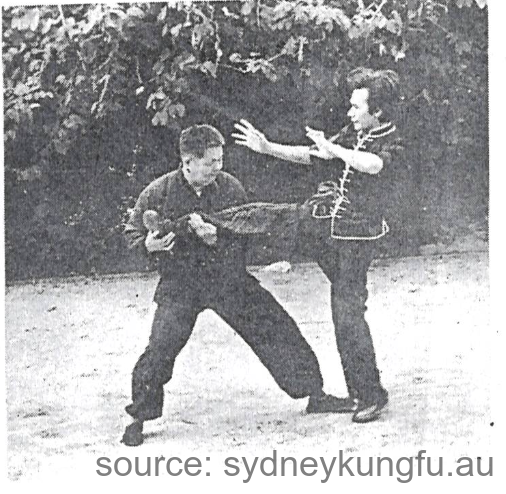
The Form of Na 拿
The five fingers are spread with the palm facing up, power is focused on the fingers, naturally open and close. In form, there are Gwaai Maa Na Jam 拐馬拿陰 (Lao 撈), Gwai Maa Na Jam 跪馬拿陰 (Lao 撈), Sei Ping Soeng Na 四平雙拿, Biu Maa Cyun Na 標馬穿拿, etc. Each form has different principles and shapes. • For example, Gwaai Maa Na Jam 拐馬拿陰 and Gwai Maa Na Jam 跪馬拿陰 have the posture of “hau zi tau tou 猴子偷桃” (monkey steals peach). Although their purpose is the same, the principles differ greatly. Gwaai Maa Na Jam 拐馬拿陰 is used when the opponent attacks, you step with Gwaai Maa 拐馬 and drop, Na Jam 拿陰 hand goes from below and reverses upward to Lao 撈 the target, belonging to unloading Lao Jam 撈陰 technique. Gwai Maa Na Jam 跪馬拿陰 is the opposite, meaning when the opponent attacks head-on, you shift and kneel with Gwai Maa 跪馬, avoiding the direct attack and use Na Jam 拿陰 hand to Lao 撈 the opponent’s vital target.
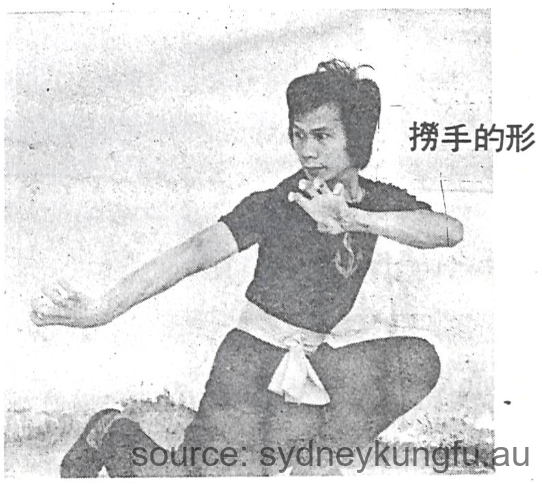
Sei Ping Soeng Na Elbow 四平雙拿肘 form is common and easy to understand in function and purpose. Generally, Sei Ping 四平 is a Bo Maa 寶馬 stance, both hands out together like “tin wong tok ta 天王托塔” (Heaven King lifts pagoda), one hand in front, one behind, front hand twists upward, back hand twists downward. The posture is like holding a tool (like a net) scooping up from below, front hand’s five fingers point upward, palm up, index and middle fingers and other four fingers together, thumb independent, like pincers open, elbow sinks down, arm slants down, forearm slants up, whole hand forms a “V J” shape. Back hand’s five fingers same as front, but palm faces down, whole hand like a flat “V”, elbow out, so the whole Sei Ping Soeng Na Elbow 四平雙拿肘 form is like two “V”s facing each other.
Biu Maa Cyun Na 標馬穿拿 form is simple, except for the stance being different from Sei Ping Soeng Na Elbow 四平雙拿肘, the Cyun Na 穿拿 form is the same as the front arm of Sei Ping Soeng Na Elbow 四平雙拿肘, but in principle and purpose, there are big differences. In principle, Biu Maa Cyun Na 標馬穿拿 is a very aggressive technique, a snatching attack. In combat, this technique targets the opponent’s tightly guarded area, Biu Maa 標馬 collides with the opponent, and when Na Sau 拿⼿ contacts the target, the five fingers grip tightly. When fully controlling the opponent, Na Sau 拿⼿ technique rotates like a spindle, twisting the target from a normal position to a reversed position. The target area is usually the head and arm.
The Meaning of Na 拿
In name, Na 拿 and Kam 擒 are hard to separate, especially in martial arts where there is a specific term Kam Na術 擒拿術 (Chin Na). Therefore, in most people’s minds, it’s hard to clearly distinguish Kam 擒 and Na 拿. In reality, Kam 擒 and Na 拿 have very different original meanings, especially in technique. Although Kam 擒 and Na 拿 can be used for similar purposes, the clear distinction is: Kam 擒 is applied and powered from above downward, Na 拿 is applied and powered from below upward. In Choy Lee Fut 蔡李佛 techniques, like Zo Kam Sau 左擒手, Kyun Maa Kam Sau 圈馬擒手, the palm edge attacks like a bow, which is very different from Na 拿. Also, in purpose, Kam Sau 擒手 usually forces the opponent down to the ground, while Na techniques 拿術 usually lift the opponent upward, making them lose balance. In other words, in combat, if the opponent is caught by Choy Lee Fut 蔡李佛 Na techniques, they may be thrown off balance and lifted off the ground, flying like a mat, or falling to one side. On the other hand, if caught by Jam Na Sau 陰拿手, the opponent may lose resistance or suffer serious injury.
Power Generation in Na 拿
Because Na Sau 拿⼿ focuses on the five fingers of the front hand, power generation requires great skill. In mechanics, Na 拿 uses rotational force, also bottom-up force, but most importantly finger strength. In combat, Na Sau 拿⼿ never clashes head-on, but follows the momentum to redirect the opponent’s force, causing them to lose balance. The whole body’s power is focused on the fingers to grip, causing pain to the opponent’s skin, plus the rotational force shifts their center of gravity. Such technique involves not only skill but also psychological tactics to achieve the purpose of Na Sau 拿⼿.