Choy Lee Fut 蔡李佛 — caap ceoi 插搥 Demonstration by Master Chu Siu Ki (Performed by To Hon Cheung)
Meaning of “caap” (caap 插)
Literally, “caap” (插) refers to using a sharp, relatively rigid object to pierce forward in a straight line or downward so the point enters and penetrates the target. In Choy Lee Fut 蔡李佛, the term applied to the palm technique “caap ceoi 插搥” carries the same idea.
The hand shape is distinct from many other styles: fingers are extended and then curled at the second joint, the thumb tucked close to the index finger. The palm is flat while force is driven through the fingers, forming a spoon-like chopping edge as if five blades were combined. caap ceoi 插搥 has yin and yang variants: the straight forward insertion (yang) and the twisting/smashing insertion (yin). In practice the angles and trajectories vary to attack different levels of the opponent. In Choy Lee Fut 蔡李佛 palm work, caap ceoi 插搥 is primarily a direct, linear attacking palm technique.
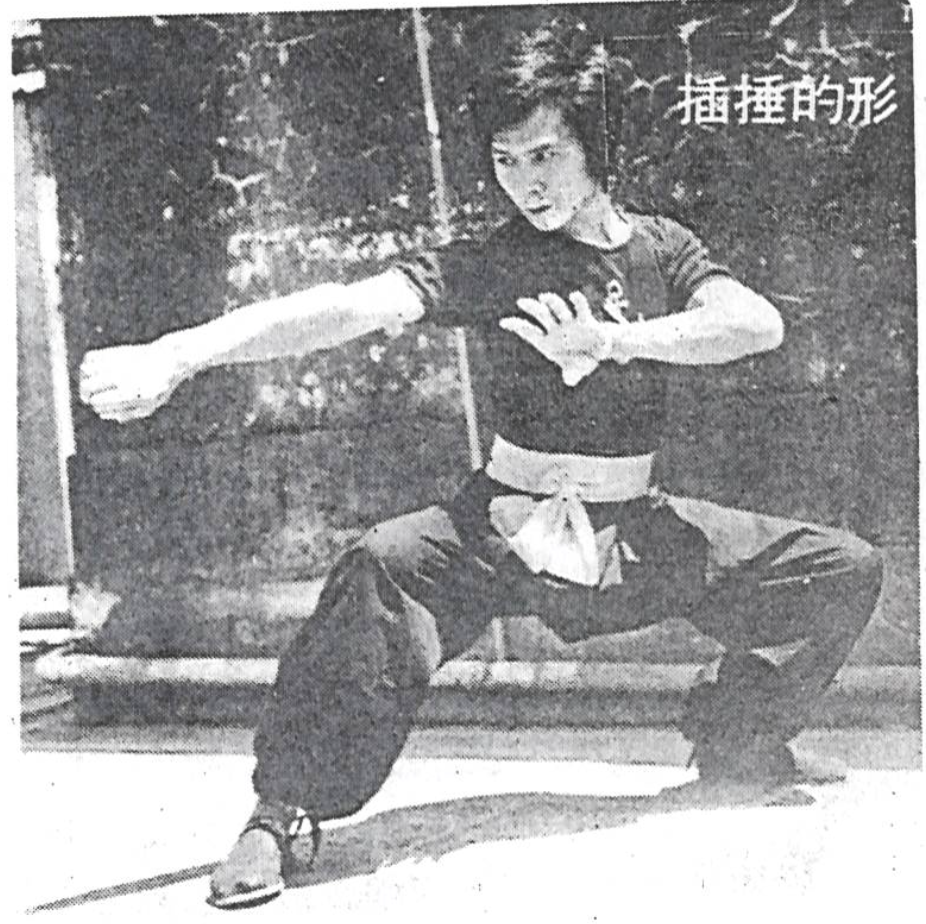
Forms of caap ceoi 插搥
caap ceoi 插搥 appears in several stances: sei ping maa 四平馬, diu maa 吊馬, and gwai maa 跪馬. Each form has both yin and yang variants.
- sei ping maa 四平馬 yang caap: the palm is driven straight out from the waist in a horizontal line until the arm and shoulder align. The body and center face the same direction; the head turns and eyes watch the opponent. When the right hand strikes, the left protects, and vice versa.
- sei ping maa 四平馬 yin caap: the strike originates from the brow or nose level at a diagonal, finishing with the fist and forearm in a straight line while the torso and center counter-rotate. In combat, yang caap often pairs with a hand clap to deliver a direct middle-level attack, while yin variations use layered timing and hooking to attack the head or neck.
diu maa 吊馬 stance: in both yin and yang versions the weight is on the rear foot while the front foot is lifted so only the toe touches the ground. This stance creates an obvious empty/filled rhythm: if an opponent retreats, the lifted front foot naturally steps forward to press the attack. If the opponent slips inside and counters, the raised front foot can quickly become a kick with little concern for weight distribution. Visually the front leg forms a bow shape while the rear leg is half-bowed.
gwai maa 跪馬 caap ceoi 插搥
The front foot is in a low riding stance like sitting a horse, firmly on the ground for weight, while the rear foot drops as if kneeling. The stance allows quick rotational shifts of center; the palm issues force directly to the opponent’s lower body in a straight line. In combat the kneeling-horse caap ceoi 插搥 rotates between yin and yang insertions and functions like a living bow, firing short, concentrated bursts. gwai maa 跪馬 strikes are close-range, risky, and generally fall under the yin category.
Power Generation of caap ceoi 插搥
caap ceoi 插搥’s power is a sudden, rotational burst delivered along a straight line. Although the strike appears linear and uses hip and stance power, from initial launch to full arm extension the palm travels through a long path. The striking energy, however, retains a rotational, explosive quality rather than being purely linear impact. Superficially it looks like a thrust, but observing the arm, muscle engagement, and directional change during application shows a combination of linear projection and sudden rotational burst.
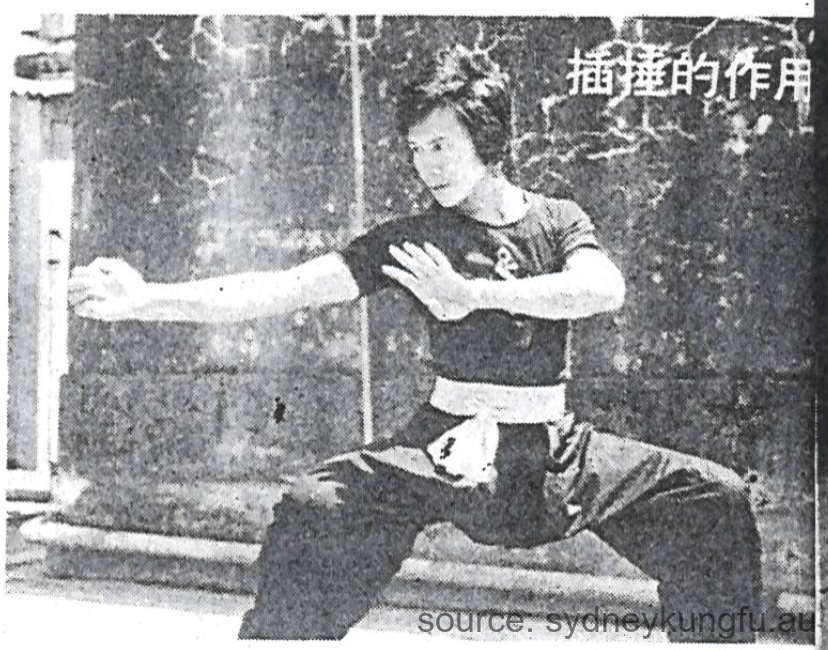
What is a rotational burst?
Before defining rotational burst, consider pure linear force: an arrow launched from a bow flies straight until it meets resistance. If the arrow hits a softer target, it penetrates; if it meets a harder object, it simply collides. That direct, penetrating force is like the yang strikes in Choy Lee Fut 蔡李佛.
A rotational burst is what happens at the instant of contact when a turning, explosive force is generated and released. In Choy Lee Fut 蔡李佛 the yin strikes make use of this quality: upon contact with the opponent the elbow and forearm muscles generate a rotational action that drives the palm into a sudden forward surge of speed and power. This rotational, sudden output is a kind of soft power — a burst of turning force that supplements the linear projection.