Shek Kin: Chief Honorary President of the Choy Lee Fut 蔡李佛 General Association
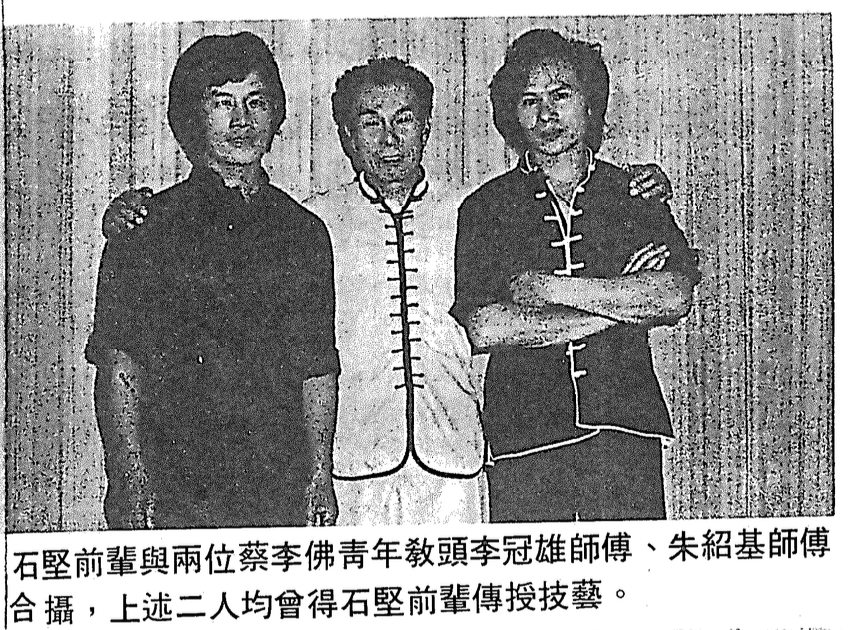
Veteran Master Shek Kin
Chief Honorary President of the Choy Lee Fut 蔡李佛 General Association
Shek Kin traded techniques with Bruce Lee and landed a punch on him in the dressing room — written by Hong Lung, photographed by Chan Chi Kwong
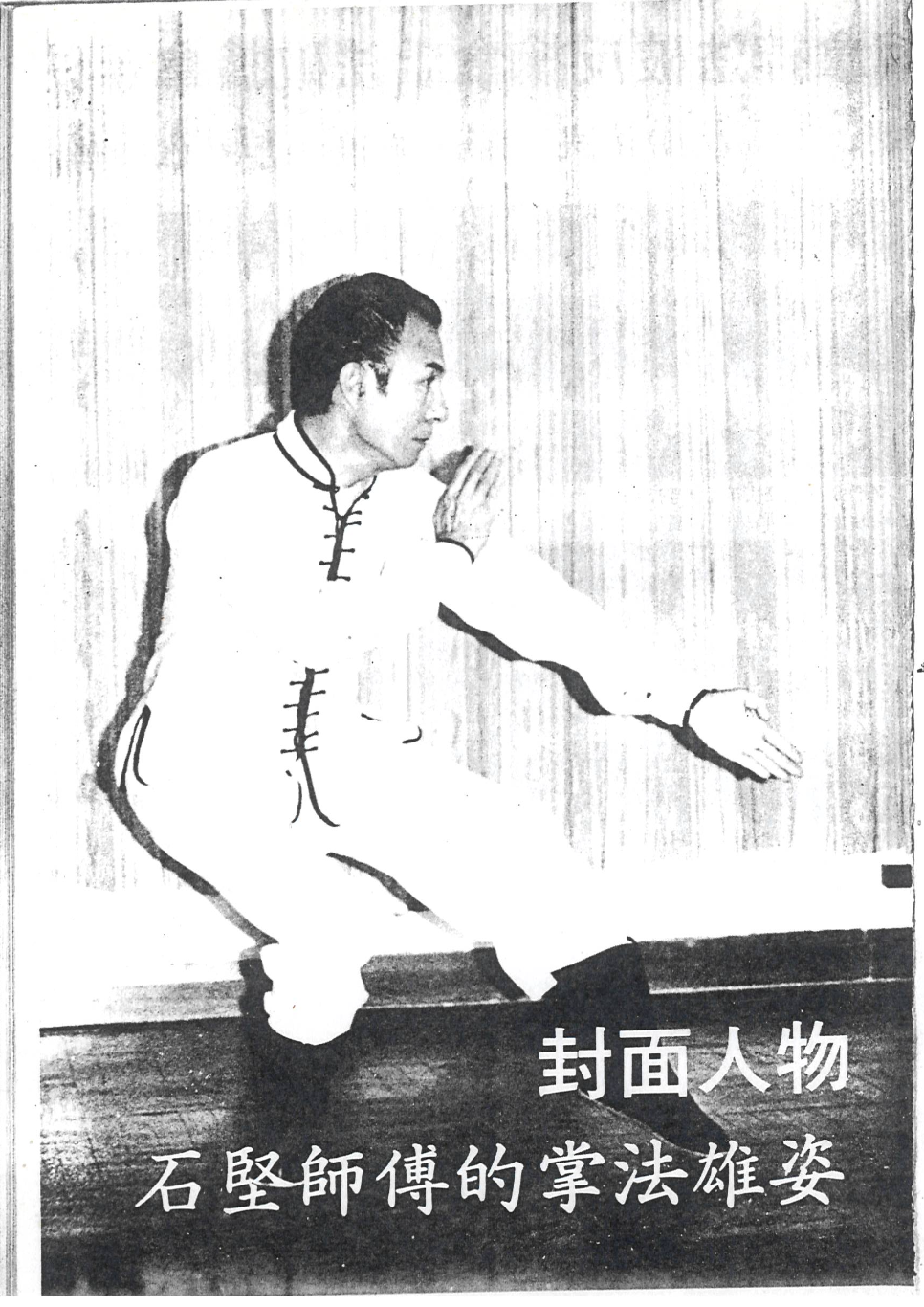
Action-film star Shek Kin. Everyone knows him as a genuine, battle-tested martial arts star. But just how good was Shek Kin’s kung fu? Shek Kin was sixty-three at the time of this interview — how much of the martial arts world’s history had he witnessed over the years? Exactly how many schools had Shek Kin studied, and how many masters had he trained under? And when Shek Kin and Bruce Lee tested their skills against each other in a dressing room, how did he manage to get the better of him? Full of curiosity about these intriguing and rather mysterious questions, this reporter was fortunate enough to secure Master Shek Kin’s agreement to a deeper profile, complete with a kam naa 擒拿 self-defence demonstration illustrated step by step for readers.
Master Shek Kin began by laying out, in detail, the schools and regional divisions of Chinese martial arts. He explained that Chinese boxing broadly splits into two great streams — southern and northern schools. Most people know that southern boxing is divided into five great families, and virtually every southern style traces back to Hung, Lau, Choy, Lee, and Mok; Choy Lee Fut 蔡李佛, for instance, is itself a branch descended from the Choy and Lee families. Northern boxing, too, can broadly be divided into five great schools, though few people know them: “Wa” (華), “Cha” (查), “Fa” (花), “Paau” (炮), and “Hung” (紅). Each of the five schools has its own distinct character, form, and regional distribution, but they share one thing in common — northern styles emphasise dodging, shifting, and leaping, with dramatic changes in low stances. Wa Kuen (華拳), for example, uses big, low pillar-stances with hands thrown all the way out, and makes heavy use of high kicks — visually very striking. It has many practitioners, and northerners generally love to learn it. As an example, many of the performers in mainland Chinese wushu troupe demonstrations base their routines on Wa Kuen. Hong Kong may well have people who know Wa Kuen, but Master Shek Kin noted that no one had ever performed it publicly here.
Master Shek Kin added that Wa Kuen has a great many forms — forty-eight sets in total. In the northern martial arts world, there is a well-known saying: “Wa Kuen has forty-eight forms; master them and you can travel the world.” This shows that Wa Kuen is one of the great mainstream branches of northern boxing.
The Five Northern Schools Along the Yellow and Yangtze Rivers
As for where Wa Kuen originated, most of its practitioners come from Hebei, with Shandong a close second — in short, the Yellow River basin is where Wa Kuen was born.
Cha Kuen (查拳) is also known by some people in Hong Kong — Master Lau Fei, for instance, teaches it here, and Master Shek Kin himself studied the fourth Cha Kuen routine. Whether Hong Kong holds any true Cha Kuen masters beyond that is anyone’s guess — there may well be hidden talents yet undiscovered. Cha Kuen’s curriculum is organised into ten routines, with wide stances and steps, pitched even higher than Wa Kuen; practitioners of Cha Kuen typically also study wrestling. The style originated in the northwest, and its practitioners were largely Muslim; it later spread south from the north. People in Shandong are especially fond of Cha Kuen, and it is also passed down in Hebei. The man said to have made Cha Kuen famous was Cha Ha Nga (查哈雅, a phonetic rendering), a northern-minority figure. Tradition holds that toward the end of the Ming dynasty, Cha Ha Nga defeated countless opponents across the land with a pair of twin hooks. Twin hooks of this kind can still be found across various schools today, though whether any of them are truly the same as Cha Ha Nga’s original weapons remains unknown.
Fa Kuen (花拳) relies mainly on techniques that confuse and distract an opponent’s eyes, with an emphasis on speed and constant change; its stances are narrower than Cha Kuen’s. It is distributed along the Yellow River basin and rarely spread south. However, some thirty years ago, a well-known master named Lee Wui Ting (李會亭) practised Cha Fa Kuen (查花拳), a hybrid of Cha Kuen and Fa Kuen.
“Paau Kuen” (炮拳) and “Hung Kuen” (紅拳) use stances similar to Fa Kuen, but their techniques are far more vicious and aggressive. They too rarely spread south, and their place of origin lies further up the Yellow River basin.
Shek Kin’s Blade and Dart Skills, Learned from Wong Wan Fung
This writer interviewed Master Shek Kin, and the more he talked, the more animated he became — once he got started on the subject of boxing, he simply couldn’t stop. I asked him how many masters he had studied under over the years, and how deep his cultivation in Chinese martial arts really went — both fascinating questions. It turns out Master Shek studied under six renowned masters, each contributing a distinct style and lineage to his skill.
(1) Chiu Lin Sing (趙連城) — Northern Shaolin school. Chiu Lin Sing’s own boxing was learned from the Axe-Head Village Shaolin lineage in Dong County, Hebei. (2) Lee Lin Chuen (李連川) — taught him Baoding fast wrestling (快跤) from Hebei, distinguished by its close-quarters throws. (3) Chiu Kwai Lam (趙桂林) — Praying Mantis (山東螳螂門) and Eagle Claw Faan Ji (河北鷹爪翻子門). Master Shek Kin said he learned a great deal of boxing from Master Chiu Kwai Lam, and recalled Master Chiu’s own words of wisdom about the cultivation needed for fighting — he was fond of telling his students: “Of all the arts, running comes first.” There is good reason behind this: beyond technical skill, a fighter’s development rests on qi and jing (氣與勁) — internal breath and structural power.
Developing raw structural power (勁) doesn’t take long — about six months is usually enough. But cultivating qi (氣) is another matter entirely — building real fighting spirit and stamina takes years of dedicated practice, not months. What, then, is the best way to train qi? Master Shek Kin pointed to running as the single simplest and most effective method.
Training qi through running isn’t just an idea embraced within Chinese martial arts circles — athletes and boxers the world over rely on running to build their wind. As for exactly how running supports boxing as a discipline, Master Shek Kin offered our readers a deeper explanation.
The benefits of running, he explained, are obvious: it builds stamina while also sharpening the agility of the limbs and strengthening the flexibility of the knee joints. When facing an opponent, Master Shek Kin said, your footwork and body method need to stay fluid and alive — only then do you have any chance of seizing the initiative. Lose that fluidity, and not only will you fail to take the initiative, you’ll find yourself constantly on the back foot — and that’s when you lose.
(4) Wong Wan Fung (王雲峯) — of the Chiu Yuen school (朝元派), popular in Shanxi. Master Wong excelled in both blade and dart work, having reached true mastery in each. Wong Wan Fung himself was known to say, in his lifetime: “Darts don’t go to Cangzhou; spears don’t clash with Shek Hung” — meaning that even the finest dart-throwers in the martial world would avoid Cangzhou, because the people there were simply unmatched with darts, their skill being of the very highest order; and no one skilled with the spear would ever challenge a man from Shek Hung, because the people there were masters of spear technique without equal. Cangzhou lies in Baoding; Shek Hung is Xiong County in Hebei.
(5) Suen Yuk Fung (孫玉峯) — of the Lohan school (羅漢門), a name renowned throughout the martial arts world and known to virtually everyone.
(6) To Chun Sing (杜振聲) — of the Shaolin school, with deep expertise in spear technique.
It was from these six masters, in his early years, that Master Shek Kin absorbed a vast store of skill — and it was this foundation that ultimately secured his standing in the martial arts world.
Shek Kin and Bruce Lee Debate Martial Theory
Having learned so many styles, was there any real, practical value to what Master Shek Kin had studied? I pressed him further on this point. Master Shek Kin explained that the true value of learning boxing lies in being able to synthesise everything you’ve absorbed and apply it fluidly. In principle, what you learn should have genuine combat value — but when you actually face an opponent, technique alone isn’t enough; you also need presence of mind in the moment, and a sound strategic approach to the fight itself.
In any given confrontation, he said, technique and raw power are actually secondary. What truly governs the outcome is your fighting mindset — power and technique are only part of the equation.
As for what that fighting mindset should look like: when facing an opponent, keep your eyes sharp and your mind clear. Don’t let your temper flare. Advance when you should advance, retreat when you should retreat — the art of it all lives in a single, calm mind.
Warming to the subject, Master Shek Kin recalled that two years earlier, while filming Enter the Dragon (龍爭虎鬥) alongside Bruce Lee, the two of them had debated fighting psychology and shared their own hard-won insights on boxing. On Bruce Lee’s overall philosophy of Chinese martial arts, Shek Kin said he largely agreed — Bruce Lee undeniably possessed a unique and cultivated understanding (more on this below). But there was one point on which Shek Kin strongly disagreed with Bruce Lee — he felt Bruce Lee’s thinking here carried a real flaw.
Their point of contention was this: when you encounter an opponent, how should you actually engage?
At the time, “Three-Kick Lee” (李三腳, i.e. Bruce Lee) stated his position firmly: “If I, Bruce Lee, meet an enemy — whoever they are — I go straight into an all-out attack, committing everything, until the other side is beaten down.”
Shek Kin strongly disagreed. In his view, when an enemy is in front of you, you should first size them up before advancing — stay composed, and never let your temper get the better of you. Bruce Lee’s approach, he argued, was the courage of a reckless man: relying on youth and physical vigour to press forward in one burst. But this leaves a serious weakness — if you fail to gauge the opponent’s real strength and the particular quirks of how they attack, you can easily capsize in what looks like calm water. Run into an opponent you’ve genuinely never faced before — someone stronger or more skilful than you — and reckless aggression only invites defeat. Shek Kin held that when crossing hands with someone, you should first probe and observe. The principle of “consideration” (慮) is critical: read your opponent’s strengths and weaknesses, their exposed points, before committing to an attack. That approach, he felt, works far better.
So — did the debate between Shek Kin and Bruce Lee ever reach a resolution?
Master Shek Kin, growing more animated still, revealed an episode from their time filming together: during a break on set, the two of them decided to put their respective fighting philosophies — Three-Kick Lee’s and Shek Kin’s — to the test, to see whose approach truly held up. The result: Bruce Lee took a kick — sorry, a punch — to the temple from Shek Kin. But it was only ever a brief trial; the two of them stopped after that single exchange and never sparred again to settle the matter further. Of course, this can’t be taken to mean Shek Kin’s skill outmatched Bruce Lee’s — it simply proved a point.
Master Shek Kin told this writer that he had no wish to build himself up by “putting down the late Bruce Lee.” Bruce Lee, he said, was genuinely superior to him in physical condition and age — the sparring on set was simply a chance encounter, nothing more than a mutual test of ideas.
Shek Kin’s Lightning-Fast Strike to Bruce Lee’s Head
Master Shek Kin went on to offer corroborating evidence of this brief sparring session with Bruce Lee. After Bruce Lee’s death, because the cause was so unusual, an inquest was convened and reopened multiple times to investigate. As part of the proceedings, the court sought testimony from people who had known Bruce Lee, and Mr. Raymond Chow (鄒文懷) himself gave lengthy testimony at the inquest. The court reportedly asked Mr. Chow directly: had Bruce Lee ever been beaten in a match (referring to actual kung fu contests)? Mr. Chow reportedly answered that yes — during a bout on a film set, Bruce Lee had once been struck on the temple by a fellow performer. That performer was Master Shek Kin.
This writer asked Master Shek Kin exactly what technique he had used to land that strike on Bruce Lee’s temple. Shek Kin was initially reluctant to go into it, but after some insistent encouragement, he finally laid out, in full, how the encounter had unfolded.
Shek Kin explained: while filming Enter the Dragon together, Bruce Lee had brought up his theories and principles of boxing. Shek Kin agreed with most of what Bruce Lee had to say, but he could not bring himself to agree with Bruce Lee’s approach to actual combat. Bruce Lee believed that when confronting an enemy, unless you chose not to engage at all, once you committed to a fight you should go all-in regardless of who your opponent was — press forward without hesitation, aiming to finish the fight in the shortest possible time. Shek Kin felt this had a real flaw: without first knowing your opponent’s strengths and weaknesses, you should first observe what techniques they favoured and gauge the level of their power and skill, before deciding how to respond. Bruce Lee did not agree with this reasoning.
And so what began as a theoretical disagreement between the two of them turned into a “friendly exchange” — or, put another way, a mock fight with real intent behind it.
During a break in filming, Bruce Lee stood up and said to Shek Kin: “Uncle Kin, let’s try a real-but-controlled exchange.” Shek Kin, put on the spot, could only laugh and agree.
Shek Kin knew full well he couldn’t match Bruce Lee in raw physical power. But he also knew he’d eaten his fair share of rice over the years in the study of boxing theory, and reasoned there might be an edge to be found there. So Shek Kin went in with no intention of launching an attack himself — he simply held to his own established principles.
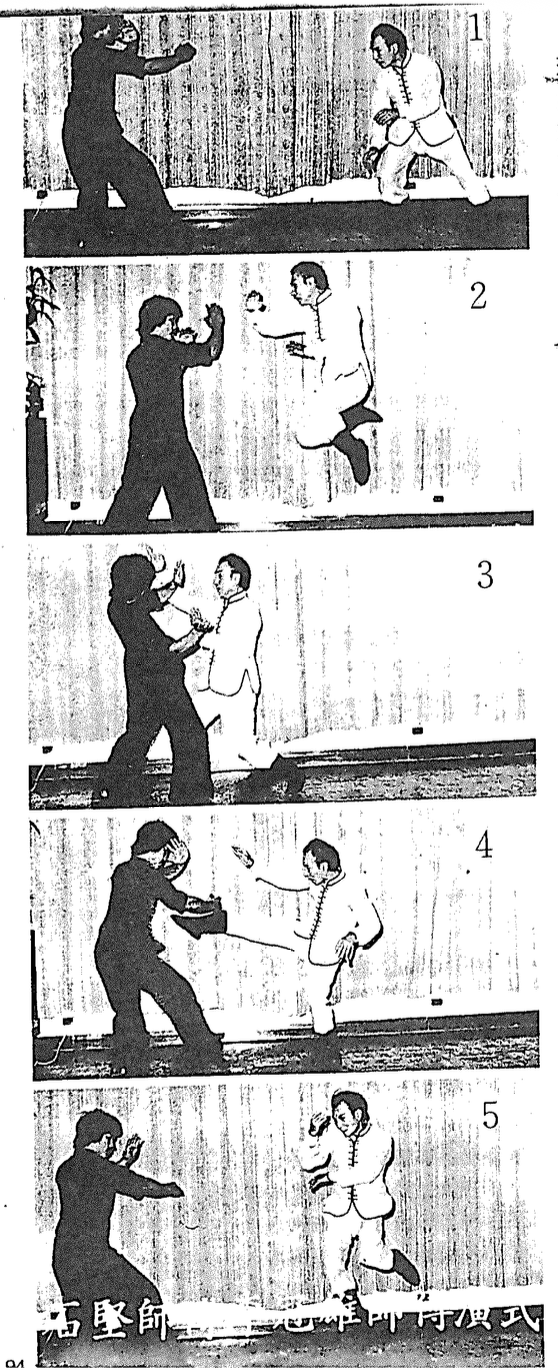
Bruce Lee, for his part, stuck to his own approach, opening immediately with a relentless series of side kicks aimed at Shek Kin. Seeing the attack come in with real force, Shek Kin retreated in irregular, unpredictable patterns — and it worked. Bruce Lee’s side-kicking advance and Shek Kin’s erratic retreats stayed matched almost step for step; several chained kicks from Bruce Lee failed to land, and by rights the exchange should have paused there. Shek Kin, unshaken, kept his composure and continued to respond calmly. Bruce Lee pressed forward again and again without gaining any real advantage, until Shek Kin finally spotted an opening. On Bruce Lee’s next charging attack, in the instant his side kick was extended but not yet withdrawn, Shek Kin seized the moment — closing the distance in a single burst, driving straight into Bruce Lee’s inside line, guarding himself with his left hand while his right fist shot straight toward Bruce Lee’s temple.
Bruce Lee, already pressed deep into his own vulnerable zone with no way to recover in time, took the hit. Fortunately it was only a real-but-controlled test, and after that single exchange, Bruce Lee reportedly grew even closer to Shek Kin — often inviting “Uncle Kin” to his home in Kowloon Tong for long conversations about martial arts.
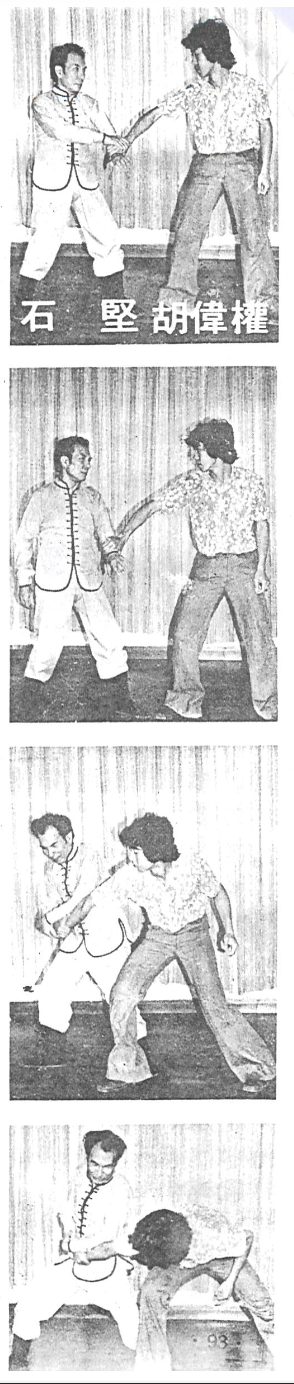
Master Shek Kin’s own knowledge of boxing runs very broad, and he has studied kam naa 擒拿 (seize-and-lock techniques) in great depth — though he rarely demonstrates them publicly. At this writer’s earnest request, he agreed to share his chin-si-tyut-sau (纏絲脫手法, “silk-reeling escape technique”) with our readers for the very first time.
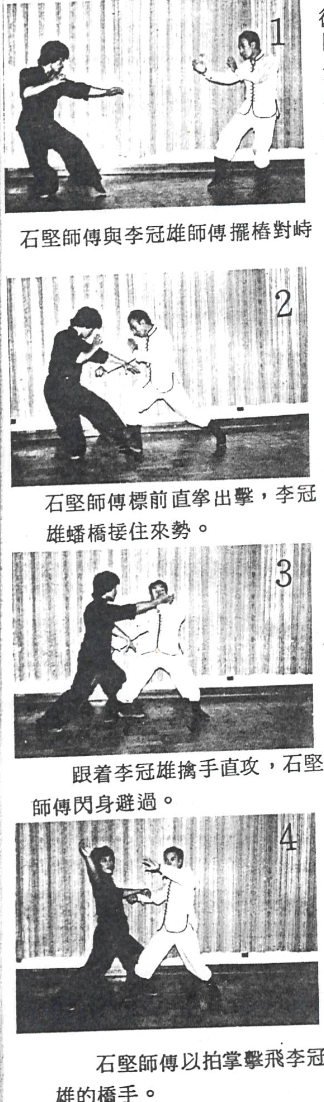
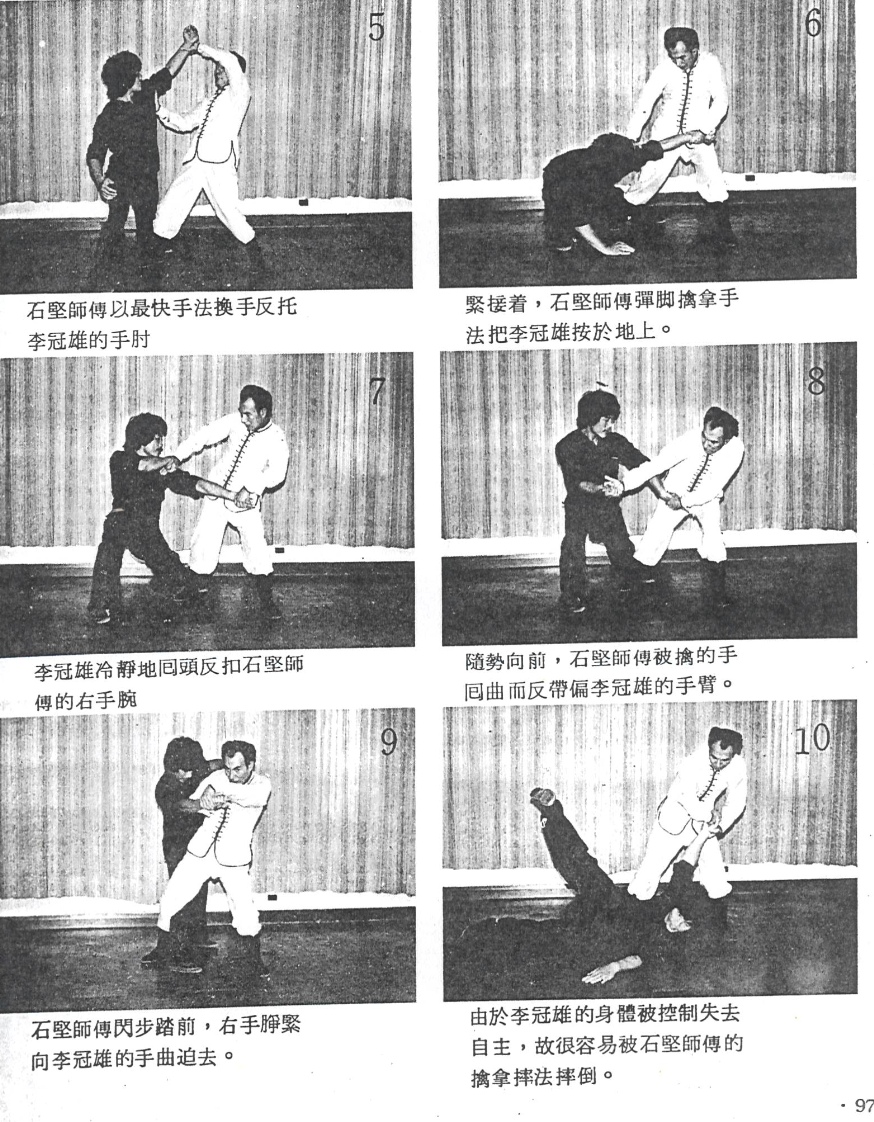
Kam Naa Throws to Counter Reversed Kam Naa, to Counter Kam Naa 擒拿摔法破反擒拿手法破擒拿手法
Demonstrated by: Master Shek Kin and Master Lee Koon Hung
Master Shek Kin and Master Lee Koon Hung take up their opening stances, facing off.
Master Shek Kin fires off a straight punch; Lee Koon Hung meets the incoming strike with a pun kiu 蟠橋 (coiling bridge-arm).
Lee Koon Hung follows up with a seizing hand straight to the attack; Master Shek Kin slips aside to avoid it.
Master Shek Kin uses a clapping palm to knock Lee Koon Hung’s bridge-hand away.
With the fastest possible hand switch, Master Shek Kin reverses and props up Lee Koon Hung’s elbow.
Immediately after, Master Shek Kin combines a springing kick with a kam naa 擒拿 lock to pin Lee Koon Hung to the ground.
Staying calm, Lee Koon Hung turns his head and hooks back to seize Master Shek Kin’s right wrist.
Following the momentum forward, Master Shek Kin’s captured hand curls back and, in turn, drags and deflects Lee Koon Hung’s arm.
Master Shek Kin slips a step forward, pressing his wrist tightly to bear down against the bend of Lee Koon Hung’s arm.
With his body now controlled and unable to move freely, Lee Koon Hung is easily thrown by Master Shek Kin’s kam naa throw.